“The fury of the virus illustrates the folly of war” – António Guterres, Secretary General of the United Nations.
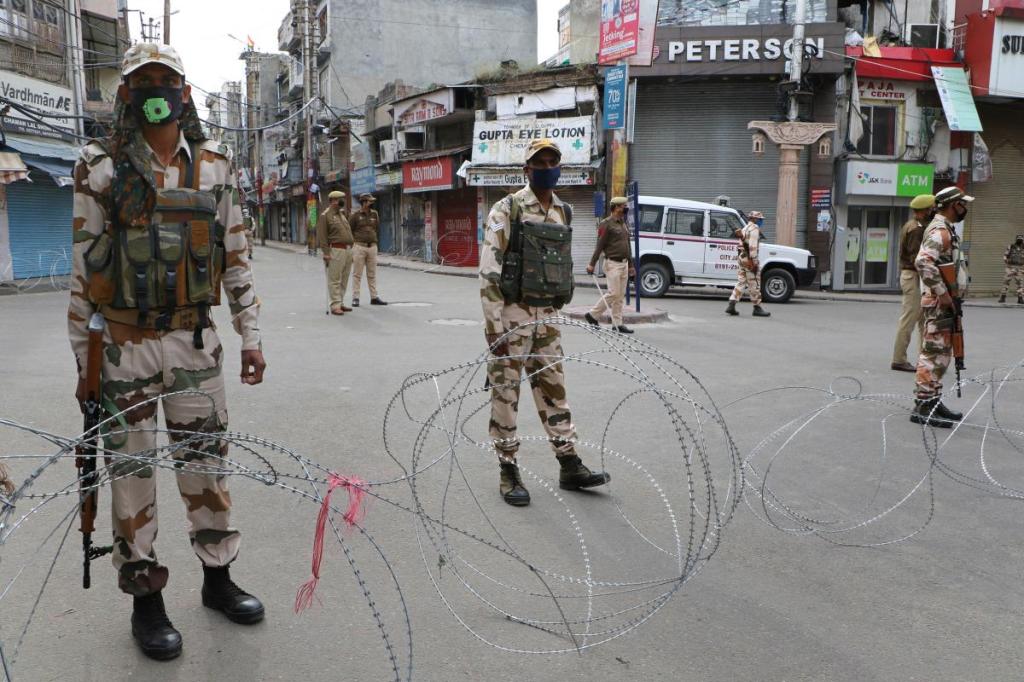
On 23rd March, 2020 the Secretary General of the United Nations called for a global ceasefire in all corners of the world to allow which would allow humanitarians to reach populations that are most vulnerable to COVID-19. However, the apparent “global ceasefire” does not seem to be implemented as Indian Government continues to violate the human rights of citizens of Kashmir. The ongoing developments in Kashmir include:
- Crackdown on Kashmiri Journalists– A 26-year old, photojournalist Masrat Zahra was booked under the draconian Unlawful Activities (Prevention) Act. A press release by the Cyber Police Station, Kashmir Zone, referred to Zahra’s Facebook account saying that she had uploaded photographs which could provoke the public to disturb law and order and further booked her for “intending to cause disaffection towards India” under the Act.
- Enhanced Curfew Measures– The lockdown is being used to push the state of exception as a normal governing paradigm. While the issue of “law and order” has been previously used by the Indian state to suspend fundamental rights in Kashmir, the tropes of public safety and health are now being used to normalise these practices. The suspension of daily life, which has over the decades become a frequent marker of punitive action against freedom-seeking Kashmiris, is now induced as part of emergency measures to protect and safeguard those same people.
- Rise in Policing Powers– By initiating gunfights with guerrilla fighters, jailing people for going to buy food and medicine, bringing charges against journalists, beating doctors, paramedics and municipal workers, India is tightening its grip on Kashmir, seizing on pandemic measures to prevent a surge of resistance to its rule.
Thousands of Kashmiris live within a 10-kilometre radius of the LoC, which is so heavily militarized that it is visible from space.
BREAKING POINT
In April, the Indian army set up artillery weapons deep in Kashmiri villages, as far as 60 kilometres from bunkered areas, to launch long-distance fire on Pakistan-controlled Kashmir. Locals are protesting the shifting of heavy artillery guns into their communities, fearing retaliatory fire from the Pakistani army. It is an intentional strategy to station soldiers and artillery among communities to make it difficult for the Pakistani army to retaliate.
The Indian army has used civilian populations as a human shield before. In 2017, a footage showing 26-year-old Farooq Ahmad Dar was circulated as he was tied to an army vehicle and was used as a “human shield” by soldiers. The people in the valley trying to escape their villages during bombardment are prevented from leaving by the police as they enforce COVID-19 lockdown measures.
ASIA’S BERLIN WALL
The LoC, also known as Asia’s Berlin Wall, does not constitute a legally recognized international boundary. It was put in place in 1949 as a temporary measure until the status of Kashmir is resolved. During the earlier years, the LoC was permeable and fluid. It was only after the Simla Agreement in 1972, that it came to mimic the impermeability of a border. The United Nations Military Observer Group in India and Pakistan (UNMOGIP) is responsible for monitoring the ceasefire. India stands accused of blocking UNMOGIP’s access to the LoC. This year alone, India has committed 882 ceasefire violations.
LACK OF EQUIPMENT
Kashmir is ill-prepared to handle the pandemic. In Indian-occupied Kashmir, there is one soldier for every 9 people but only one ventilator for every 71,000 people, and one doctor for every 3,900 people. Health facilities along the LoC are severely deficient, reflecting India and Pakistan’s neglect of the sub-region. Given the current suspension of high-speed 4G internet, Kashmiris are prevented from “Work from Home” and accessing necessary public health information needed to slow the spread of COVID-19. Internet and telecommunication services are restricted on both sides of the LoC.
KASHMIR: YET TO COME
The pandemic has inspired thinking on restructuring of the world around us and the real state of affairs, most of the people are not aware about the brutality and hardships the citizens of Kashmir Valley face on a daily basis, the lockdown has significantly increased the deprivation of the people. A just world won’t emerge as if by magic. We will need to fight for it.
The global pandemic is forcing us to imagine “a world we do not yet know and cannot describe”.
 ForeSight